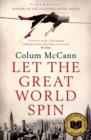
 Two things led to this book. The recommendation of one of my more sensible customers, and the fact that it had a link to an event that has long fascinated me - the tightrope walk between the (then almost constructed) towers of the World Trade Centre in New York, in August 1974. It was good that they did lead me there, for few books have ever held me so well in their grip [maybe Birdsong or Owen Meany] as this did.
It is a story of two brothers, of New York, poverty drugs and prostitution, despair at the loss of a child in war, artistic excess, frustration at the state of society: told as a series of stories, they are loosely intertwined with the bizarre stunt of Philippe Petit's walk in the sky and a tragic accident. The setting of those great twin towers and their ultimate demise, never mentioned but always in our minds, is masterful. They are connected so delicately and with such great writing that it sometimes takes your breath away. One passage stands out - there is a wonderful description of the effect the glass walls of the new twin towers had on birds, who would constantly fly, confused, straight into them, and the lady who kept collecting their bodies. It took me straight back to that dreadful afternoon of Sept 11th, 2001 when the bodies falling from the glass towers were not birds.
The Corrigan brothers grow up in the rough end of Dublin, and although told largely from the viewpoint of Ciaran, it is really his brother John [forever to be known just as Corrigan] who is the real subject of much of the tale. Drawn from an early age to look after the drunks and vagrants of Dublin, and the demons who drive them there. He is destined for radical priesthood, settling in the Bronx of a failing and bankrupt New York. He provides shelter and comfort for the drug-addicted street prostitutes, regarded by the police as a pimp and by the pimps as a madman.
At the same time Claire is a grieving mother, living in luxury in the Upper East Side, distraught at the loss of her son in a pointless act in Vietnam; only finding solace in a self-help group of mothers in the same position. Her husband is a judge, driven to distraction by the hopeless justice system he has to keep working, and driven to work harder by his grief. Blaine and Lara are wealthy artists, making and consuming the most of what New York's artist community has to offer. Tilly and her daughter Jazzlyn, herself with baby daughters, are hopeless heroin-addicted cheap hookers, forever hoping for a promised land but ever-destined never to see it.
Written with the balance and skill of Petit's skywalk, the collision of their worlds is beautiful. If I have a criticism, it is that having swept us along for the first 250 pages, the final 100 do not quite reach the high standard he has set himself. The writing is as good, but many sections seem to have little purpose and to tell us thing that we do not need to know, the circle of life having already been completed. It could be a case of less being more - but do not be put off, it is as good as anything I have read all year.